

Visual DAQ Icon


Unifosys Icon

Data Acquisition (DAQ)

Definition and Components

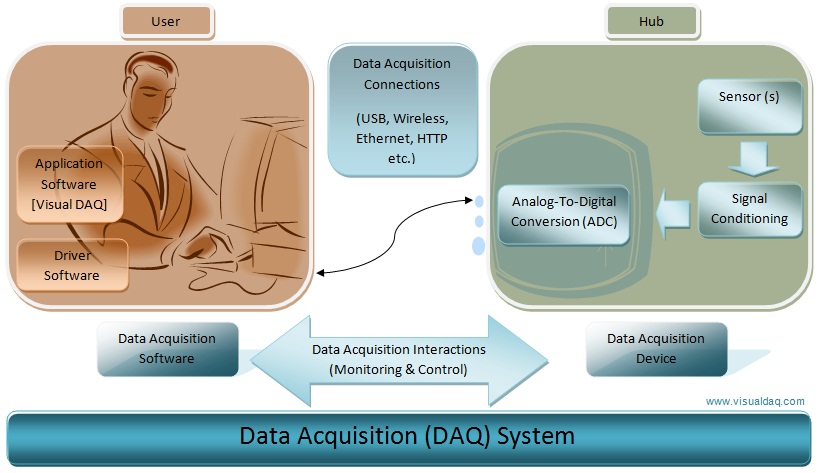
Data Acquisition System Components

Data Acquisition (DAQ) is the process of measuring environmental conditions.

The DAQ process involves the sampling of signals that represent environmental conditions, converting the resulting samples into numeric values, and data-processing of those numeric values by a computer. DAQ is basically analog to digital conversion (ADC) and data analysis. Electrical signals are converted to digital values (voltage, current, resistance, temperature, humidity, airflow etc.).

Components of a Data Acquisition System

1. DAQ Hardware (Sensor Network)

  • Sensors: Convert physical parameters to electrical signals.
  • Signal Conditioning: Convert electrical signals into a form that can be converted to digital values.
  • Analog-to-Digital Converter (ADC): Convert conditioned signals to digital values.

2. DAQ Software

  • Driver Software: Provides an interface between application software and DAQ device hardware/firmware.
  • Application Software: Provides interaction between computer and user, to analyze and visualize acquired data. Read more

3. DAQ Connections (Channels & Protocols)

  • Communication Channel(s): The connection mechanisms through which data can be transferred between DAQ device and computer.
  • Communication Protocol: The data format specification of the acquired data.

4. DAQ Interactions (Monitoring & Control)

  • Data Monitoring: Periodically inspect the changes happening in environmental conditions.
  • Device Control: Direct the device to change other environmental conditions, in order to influence the acquired environmental conditions.